Kannitverstan
About this story
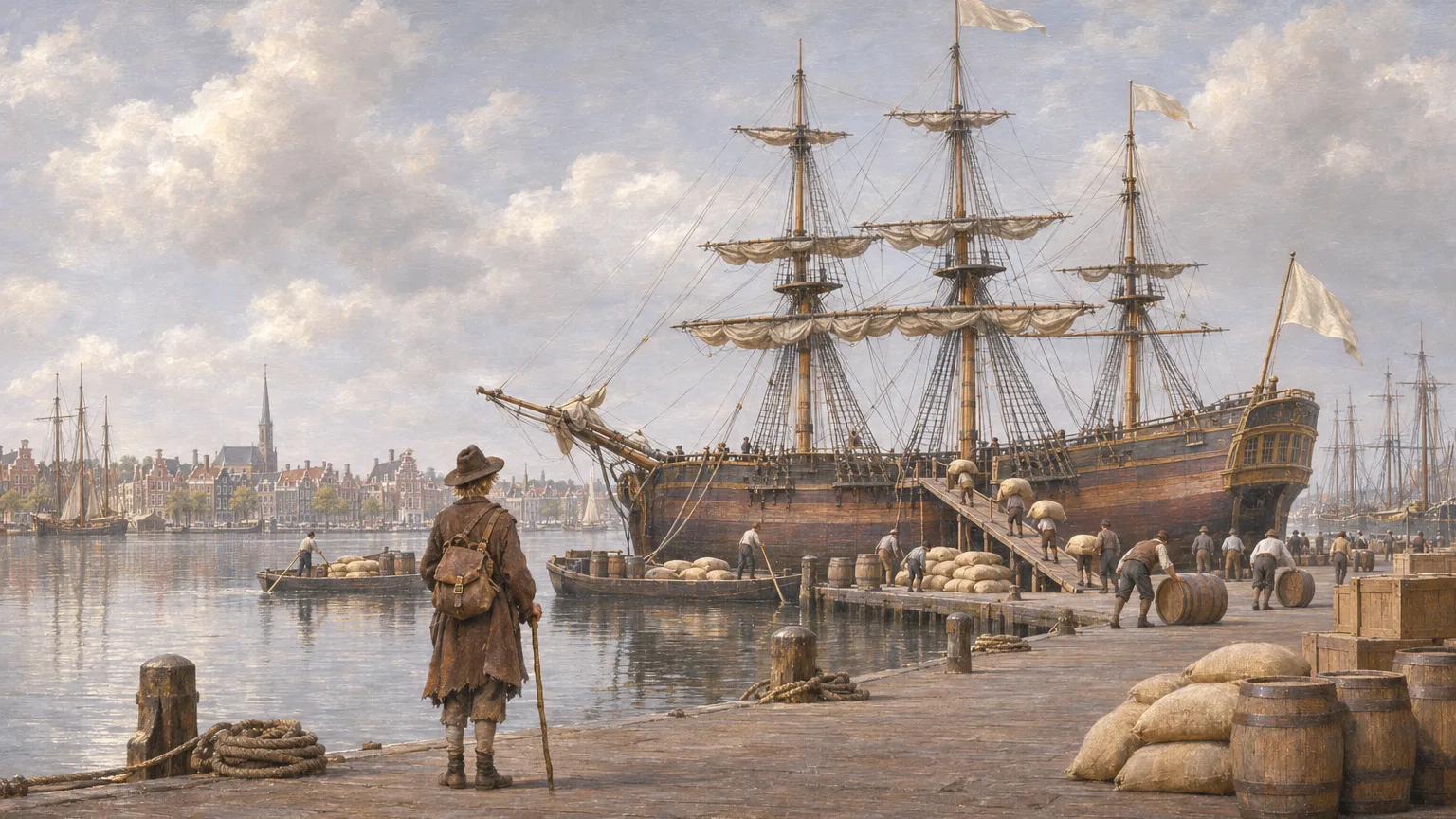
A young journeyman from Tuttlingen walks into Amsterdam and stops before a house with six chimneys and tulips at its windows. Whose is it? A passer-by grunts “Kannitverstan” and hurries on. At the harbour a ship in from the East Indies is unloading sugar, coffee and pepper: whose cargo? “Kannitverstan.” The lad envies this rich Mr Kannitverstan, until a funeral procession turns the corner and he asks who is being buried. The whole tale hangs on a Dutch phrase that means only “I can’t understand you”, which he mistakes for a name: a fitting first read for language learners. Johann Peter Hebel printed it in 1808 in his almanac Der Rheinländische Hausfreund. It has stood in German school readers ever since, and Elias Canetti recalled it in his memoir.
By the numbers
About the author

Johann Peter Hebel (1760–1826) was a German-language writer, Lutheran theologian and schoolmaster from the Upper Rhine. Born in Basel, he spent most of his life in Karlsruhe, where he directed the gymnasium and rose to prelate of the Lutheran church of Baden. His Allemannische Gedichte (1803), warmly reviewed by Goethe, founded modern Alemannic dialect poetry. From 1807 he edited the Baden almanac Der Rheinländische Hausfreund, and the Schatzkästlein des rheinischen Hausfreundes (1811) made him the classic master of the German calendar story, later admired by writers as different as Kafka, Brecht, Benjamin and Canetti. “Kannitverstan”, first printed in the almanac in 1808 and collected in the Schatzkästlein in 1811, is, together with “Unverhofftes Wiedersehen”, his best-known story and has remained a fixture of German school readers.
Recognition
My life had begun with the experience of Kannitverstan, when my parents talked to each other in a language I did not know […] I do not believe there is any book that has imprinted itself on me so completely and in every detail […]
… in the account of the fate of Herr Kannitverstan, unsurpassed by any German storyteller. Through the genuinely poetic quality that lies hidden in our language, he turns a French anecdote into a parable of the world.
Even Paul Celan, a poet wrongly labelled ‘hermetic’ and considered as remote as can be from any popular mode, alluded to the story ‘Kannitverstan’ in a poem—perhaps only because this piece has become as proverbial in German as Luther’s Bible.
… that the narrative process of the ‘Kannitverstan’ story by no means asks to be understood merely as an odd curiosity, but develops a certain parable-like quality for all human understanding.
Practice typing
Type this retelling one piece at a time — your progress is saved as you go.
If you liked this

Down to his last coin, Castelo answers a newspaper advertisement seeking a teacher of Javanese — a language of which he does not know a single word.

Jim Smiley will bet on anything: a horse race, a dog fight, which of two birds leaves the fence first, even whether the parson's sick wife pulls through.

Mathilde Loisel, a pretty clerk's wife who aches for a life of luxury she will never have, borrows a glittering diamond necklace from a rich friend to shine for one night at a grand ministry ball — and loses it on the way home.

Two weeks into her marriage, a young bride lies awake beside her sleeping husband, proudly bearing the weight of his fair head on her shoulder.